
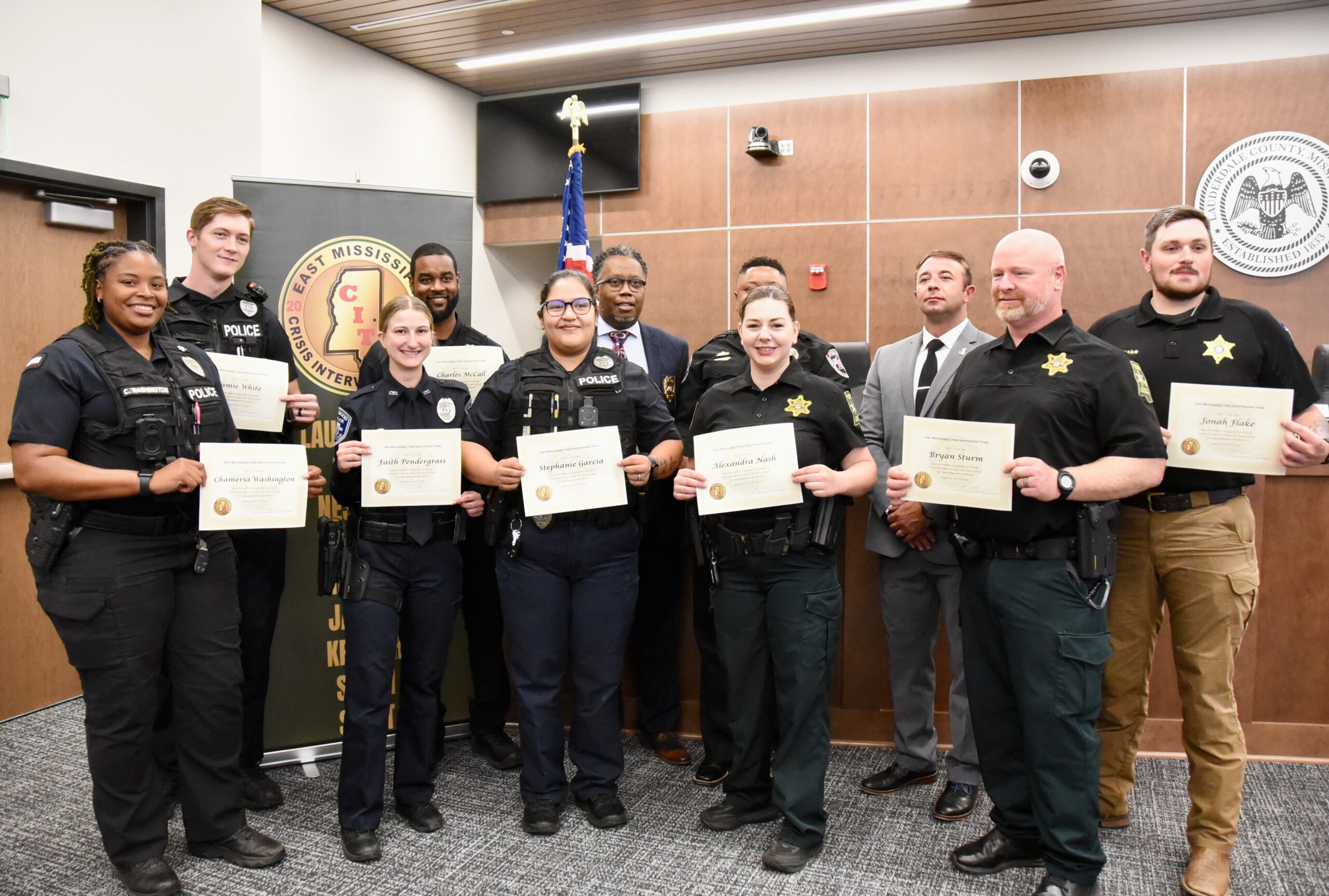
A dozen law enforcement officers are returning to their communities with new ways to help people after spending a week in Meridian going through an intensive 40-hour Crisis Intervention Team Officer Training. The course, hosted by the East Mississippi Crisis Intervention Team, is specially geared to prepare officers to respond to people in mental health crises and get them the help they need.
Lauderdale County Sheriff’s Department’s Lt. Andy Matuszewski, who also serves as the program manager for the East Mississippi Crisis Intervention Team, said being a CIT officer isn’t a job just anyone can do, but the 12 recruits proved themselves over the course of the week.
“This week has been full of a lot of new experiences for our students. Many of them have been in the field for some time, but when you get serious about dealing with crisis issues, you have to look through a different lens,” he said. “You have to learn what the world looks like to the people that you engage with.”
Officers are taught about pharmacology, critical clinical states, what it looks when someone is having a psychotic episode, legal issues and more, Matuszewski said. Learning to look at a situation as another person sees it is uncomfortable, but that is what the job requires. If the roles were reversed, he said, how would officers want people to respond?
“What if it were you? What if it were your loved one? How would you want people to respond,” he said. “Have the patience that it takes.”
Sheriff Ward Calhoun said many of the skills taught during the training are also applicable to other situations officers will encounter on a regular basis. Talking to people, establishing relationships and building trust are essential parts of the job.
“Take this newfound knowledge and use it to help people,” he said. “I hope you’re here for that, and I hope you wear a badge to serve others. That’s what we’re here to do.”
Meridian Police Chief Malachi Sanders, who had five officers participating in the CIT course, said mental health is intertwined with being a first responder, and it’s a topic law enforcement needs to put more attention toward. Officers graduating from the course will now be able to put their skills to use in the community to help connect people with the resources they need.
“You’ll be part of our team of law enforcement professionals that’s going out and being able to recognize these people that mental illness and take the appropriate steps to get them help,” he said.
Crisis intervention stretches beyond law enforcement or first responders. It is a community effort, Calhoun said. Mental health professionals, advocates and support organizations, as well as those with previous mental health history all work together to connect those in crisis with help.
As CIT officers work in their communities, there will be times when things don’t go according to plan. A crisis center may be full, or some other issue pops up. In those moments, the crisis intervention community is there to help, Calhoun said.
“There are other people who can help find solutions whatever the issues are, the challenges that you find,” he said. “You just have to reach out and ask, use those relationships and make that happen.”