
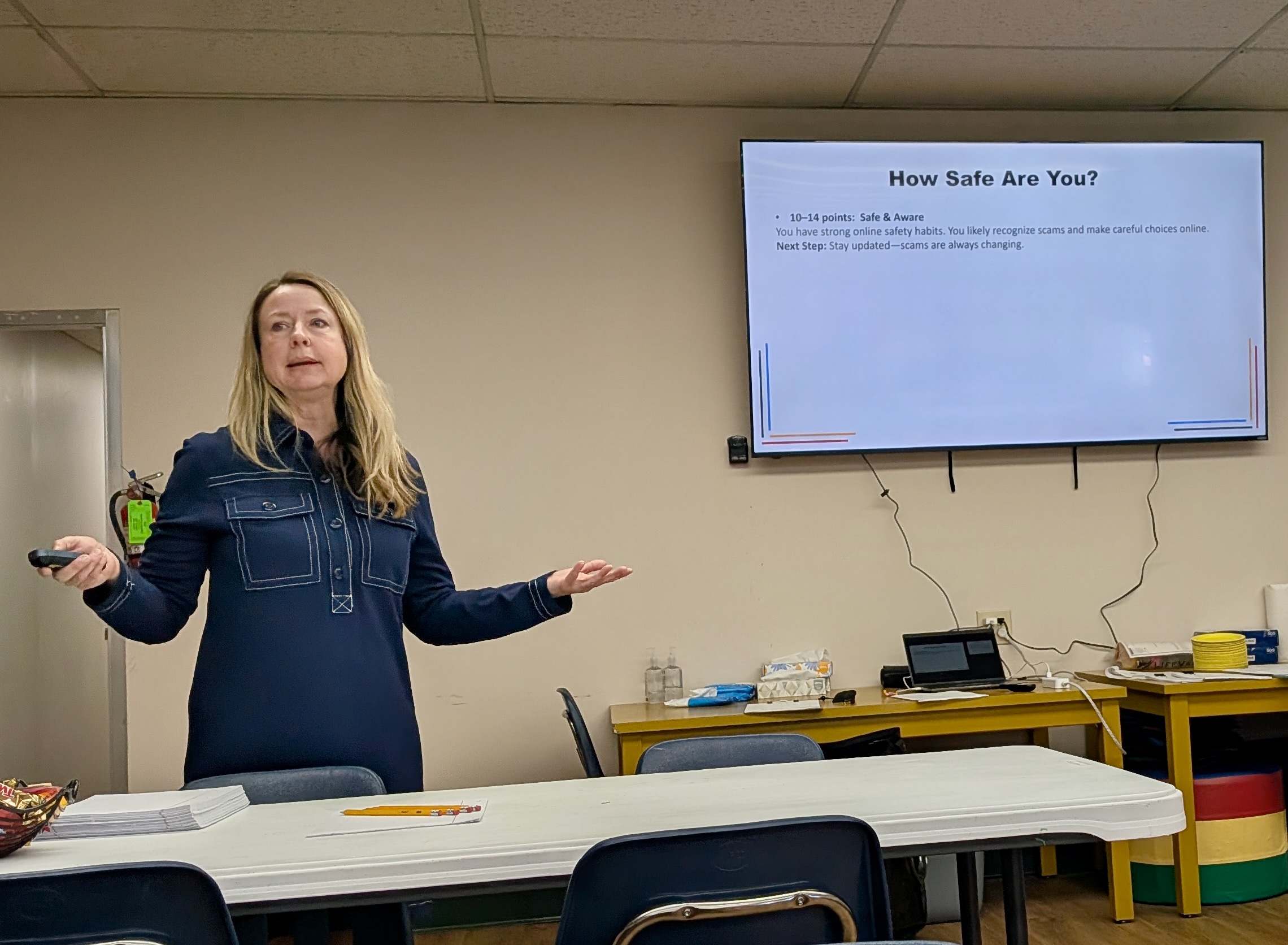
Lauderdale County residents learned more about keeping their digital information safe on Friday during an internet safety training at the Meridian-Lauderdale County Public Library
Lori Matzek, with the Mississippi State Extension, said there are simple steps people can take to lower their online risk such as using strong passwords, turning on multi-factor authentication and watching for potential scams.
Not too long ago, the recommendation for a strong password was six to eight characters, Matzek said, but that has now doubled to 16 characters or more. A strong password also includes a combination of upper and lowercase letters, numbers and symbols, and doesn’t use personal information such as a pet’s name or match a password used for another site.
For those concerned about remembering longer passwords, Matzek suggests using a pass phrase instead of a password.
Multi-factor authentication is another digital security feature that is becoming more prevalent. Users are often asked to enter code received through a text, email or phone call when trying to log in as a second level of security. Biometric features such as fingerprints or face recognition are also forms of multi-factor authentication.
Scammers come in all forms including online, via email, text message and phone calls. Popular scams include grandparent scams, where someone presents to be a grandchild needing bail money or emergency cash, tech support scams, government scams such as pretending to be from Medicaid, financial services, and romance. All scams, however, share some common traits that can be a sign things may not be legitimate.
Matzek said scammers want to create a sense of urgency, making their target feel they must act immediately. They ask for personal information, tell victims to keep their call a secret or not to involve law enforcement. Asking for payment in unusual methods such as gift cards or cryptocurrency is also a big red flag, she said.
One simple way to check a suspicious call or email from an organization is simply to give them a call. Use the publicly available number, not the information provided by the suspected scammer, and ask if the call or email was legitimate.
The internet, and now artificial intelligence, have made it easy for bad actors to prey on other people, but with some simple precautions and healthy skepticism, residents can reduce their risk of having their data stolen or falling victim to any schemes.